
 SEARCH
 LIST YOUR PROPERTY
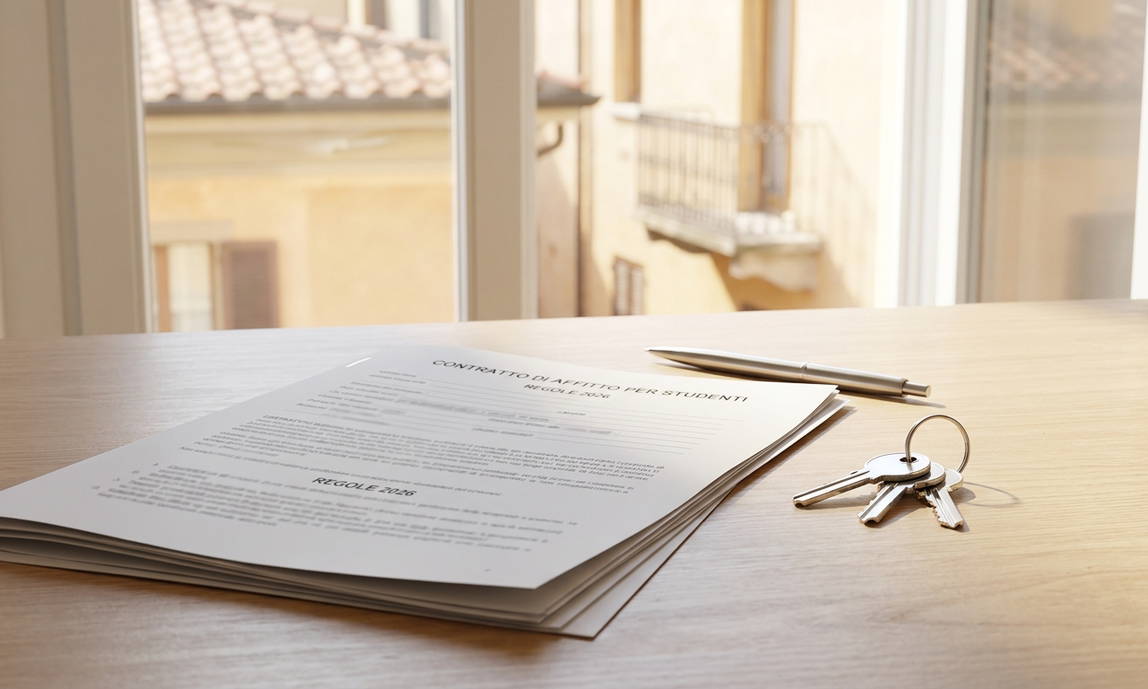
Given the student housing crisis hitting major Italian university cities head-on, finding a room can sometimes feel like an uphill battle. Whether you are looking for student shared housing in Milan, Rome, or Bologna, the 2026 academic year brings its share of legislative changes. The Italian government has indeed adjusted the legal framework to address the shortage of beds and encourage rentals. At Roomlala, we have broken down the specifics of the 2026 Italy student contract (Contratto per studenti universitari) to help you get a clearer picture. Whether you are a host looking to rent out a room or a student looking for a place to live, discover how these new rules protect your rights and optimize your budget.
Understanding the 2026 Italy student contract (Contratto per studenti universitari)
Basic terms of the student lease
The Contratto per studenti universitari is a legal mechanism specifically designed for students who are away from their home city (fuori sede), meaning those who officially reside in a different municipality than the one where they study. This status is essential because it justifies the temporary and regulated nature of the lease. In 2026, the legal duration of this contract remains strictly regulated: it must be between 6 and 36 months. This flexibility is ideal for adapting to the academic cycle, whether it is an Erasmus exchange semester or a full bachelor's degree cycle (Laurea).
Read also: Porta 65 Jovem program in 2026: How to finance your room in a shared housing in Portugal, Student lease vs. standard furnished lease: Which option should you choose for renting your room for the 2026 school year? and 2026 Student Back-to-School in Brussels: Everything you need to know about student leases and shared housing
To be valid, this contract can only be concluded in university cities or recognized neighboring municipalities. It is imperative to use the standard ministerial model approved by the Italian government. Any major modification of the standard clauses in this model may result in the nullification of the benefits attached to it, both for the tenant and the host.
Let’s take a concrete example: if you are a student from Naples and you go to study at the University of Bologna, you are eligible for this fuori sede contract. The host may offer you a 12-month lease, automatically renewable for the same duration, unless you give notice within the established deadlines. Generally, the notice period is 1 to 3 months before the expiration date, depending on what is stipulated in the clauses of your 2026 Italy student contract.
Developments related to the 2026 Decreto Casa and the PNRR
The year 2026 marks a decisive turning point with the implementation of the new Decreto Casa and the acceleration of measures from the National Recovery and Resilience Plan (PNRR). To address the glaring shortage of rooms, particularly in the context of student shared housing in Milan or Rome, the PNRR and the Cassa Depositi e Prestiti (CDP) have unlocked a massive fund of 579 million euros. The goal of this government initiative? To accelerate the creation of new university beds and relieve pressure on the private rental market.
In parallel with this major construction plan, the government has refinanced the national rental support fund with an envelope of 8.5 million euros specifically dedicated to students. This valuable aid targets lower-income profiles whose Equivalent Economic Situation Indicator (ISEE) is below 20,000 euros. It is a real breath of fresh air for many families facing rising rents.
These measures aim to rebalance a market under extreme tension. At Roomlala, we observe that these initiatives reassure both students, who benefit from a financial safety net, and hosts, who see the solvency of their tenants strengthened by these direct or indirect state aids.
Italy host tax benefits: The power of the Cedolare Secca
A reduced 10% tax rate
On the host side, Italian room rental law provides powerful levers to encourage the supply of student housing on the market. The main advantage lies in the optional tax regime of the cedolare secca. In 2026, opting for this regime allows the host to benefit from an exceptionally low fixed tax rate of 10% on rental income generated by the room or apartment.
By comparison, a standard lease (4+4 years) or a non-subsidized transitional lease is generally subject to a cedolare secca of 21%, or even to progressive income tax (IRPEF), which can be much higher depending on your tax bracket. Furthermore, choosing the 10% cedolare secca completely exempts the host from registration taxes (imposta di registro) and stamp duties (imposta di bollo) when registering the contract with the Agenzia delle Entrate.
Here is a very telling use case: You rent a room in shared housing in Rome for 400 euros per month. Over a year, your rental income amounts to 4,800 euros. With the 10% cedolare secca, you will only pay 480 euros in taxes on this amount, with no additional registration fees. This is a significant argument that encourages many hosts to prioritize student rentals via secure platforms like Roomlala.
The obligation to respect the canone concordato
Be careful, however, these Italy host tax benefits are not granted without strict conditions. To be entitled to the reduced 10% rate, the host has an absolute obligation to respect the canone concordato (regulated rent). The rent amount cannot be set freely based on supply and demand: it must fall within the price ranges defined by the local territorial agreements (Accordi Territoriali) signed between the landlords' and tenants' unions of the municipality.
These price grids take into account multiple specific criteria to assess the fair value of the property:
- Geographic area: the rent varies depending on whether the property is located in the historic city center or on the outskirts.
- Surface area: the size of the private room and the shared common areas.
- Furnishings: the presence of quality furniture, new bedding, or recent appliances.
- Included services: fiber-optic internet, an elevator, a balcony, or concierge service.
It is crucial to have the rent calculation validated by a certificate of compliance (attestazione di rispondenza) issued by a signatory union. In the event of a voluntary or accidental breach of this ceiling, the consequences are severe: the host immediately loses the right to the 10% cedolare secca and faces a severe tax adjustment from the Agenzia delle Entrate, with the retroactive application of the standard rate and late payment penalties.
Rights, support, and security for student tenants
IRPEF deductions and new financial aid
Italian legislation actively protects students and offers them significant financial benefits to reduce the cost of their studies. One of the fundamental rights linked to the 2026 Italy student contract is the possibility of deducting part of your rent from your taxes. Students, or their parents if they are still attached to their tax household, can deduct 19% of rental costs from their IRPEF.
In 2026, this deduction applies to a maximum expenditure ceiling of 2,633 euros per year. Concretely, this represents a tax saving of up to approximately 500 euros per year. For a scholarship student or someone on a tight budget, this sum is far from insignificant and helps cover part of daily life, transport, or school supplies.
To activate this tax deduction with the Italian tax authorities, several golden rules apply:
- Traceable payment: all rent payments must be made by bank transfer, credit card, or any other electronic payment method.
- Cash prohibition: cash payments immediately invalidate any request for a tax deduction.
- Document retention: the student must carefully keep a copy of the lease registered by the host and the monthly rent receipts.
Italy room rental law: How to avoid scams
Faced with the urgency of finding a place to live before the start of the academic year, some students may unfortunately fall into the traps of fake hosts, especially on social media or unmoderated classifieds sites. Preventing scams is an absolute priority under Italian room rental law. Rule number one is to never pay a security deposit (caparra) or the first month's rent before having formally visited the property.
It is also essential to remember that the contract must be formally registered with the Agenzia delle Entrate within 30 days following its signing by both parties. Without this official registration, the lease is considered void (affitto in nero), depriving the tenant of any legal protection in the event of a dispute and their rights to the tax deductions mentioned above.
At Roomlala, we actively fight against these fraudulent practices that pollute the market. By using our platform, host profiles are verified, and financial transactions are fully secure. Payment is only released to the host once the student has taken possession of the premises in accordance with the agreement, thus offering complete peace of mind to tenants and their parents.
Student shared housing in Milan and Rome: How Roomlala supports you
Finding student shared housing in Milan, Rome, or any other popular large Italian university city like Turin or Florence requires method and responsiveness. The market is extremely dynamic, and the best rooms are taken in just a few hours. This is where Roomlala’s expertise makes all the difference in facilitating trusted connections between hosts and tenants.
We provide our community with simple and intuitive tools to secure each step of the rental process. For hosts, publishing a listing on Roomlala makes it easy to quickly find serious students with completed and verified profiles. We help you highlight your offer by showcasing the assets of your property, while reminding you of legal best practices such as using the 2026 Italy student contract and mandatory registration.
For students, Roomlala is the guarantee of a stress-free housing search. Our integrated messaging allows you to chat directly with hosts to ask all your questions about neighborhood life, existing roommates, or utilities before booking. No more useless visits or unpleasant surprises upon arrival: you book online in a 100% secure and regulated manner.
In conclusion, the new student shared housing rules in Italy for the 2026 academic year offer a truly win-win framework. Hosts benefit from highly advantageous taxation thanks to the 10% cedolare secca, while students enjoy regulated rent, aid strengthened by the Decreto Casa, and valuable tax deductions. By relying on the support and security of Roomlala, you have all the cards in hand for a peaceful, perfectly legal, and humanly enriching rental experience.


There are no comments yet.
Add a comment
You must be logged in to post a comment.