
 SEARCH
 LIST YOUR PROPERTY
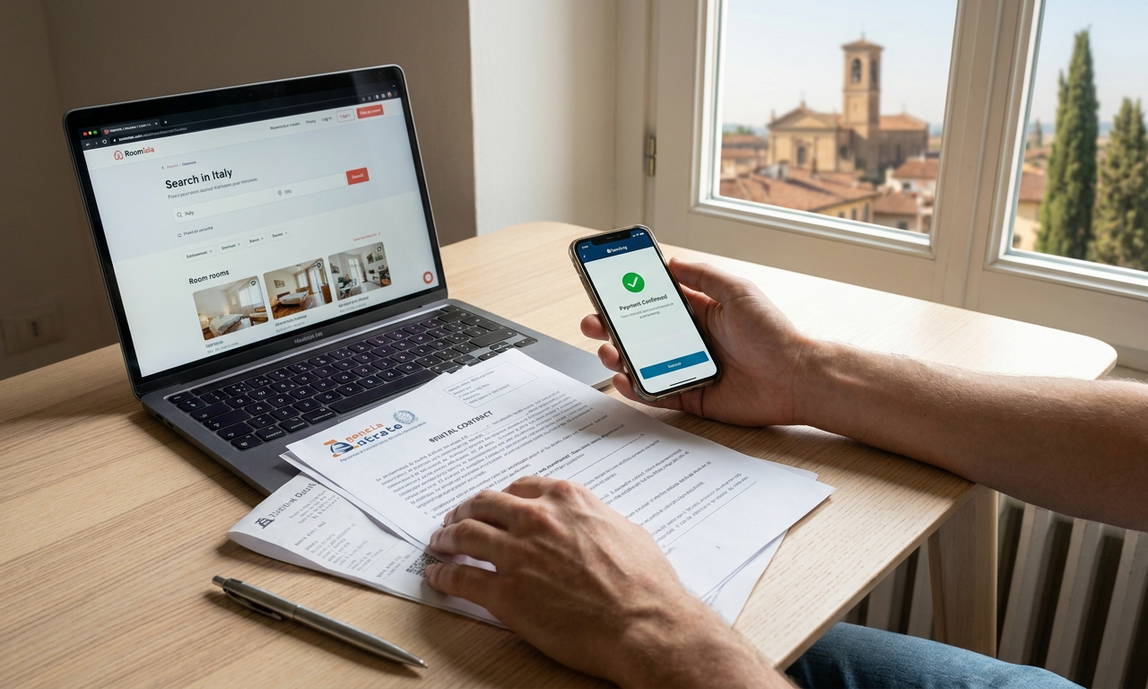
At the start of the academic year, the search for accommodation is often synonymous with stress and significant expenses for many families. Major Italian university cities like Milan, Rome, Bologna, or Florence have particularly high rents, which weighs heavily on household budgets. Fortunately, the Italian government has implemented aid programs to lighten this financial burden. At Roomlala, we know how crucial it is to optimize your housing budget. That is why we are offering a complete breakdown of the 2026 tax deduction for 'fuorisede' (non-resident) students. This specific status allows you to recover a significant portion of the rent paid, provided that strict rules set by the tax authorities are followed. Whether you are renting an entire apartment or a simple homestay, this guide explains step-by-step how to benefit from this major legal advantage.
What is the 2026 'fuorisede' student status in Italy?
Strict geographical criteria to follow
For a student to be officially recognized as 'fuorisede' (literally 'off-site' or away from home) by the Italian tax administration, simply leaving the family nest is not enough. The law imposes very precise mileage and geographical criteria. In 2026, the university where the student is enrolled must be located at a minimum distance of 100 kilometers from their primary residence. Furthermore, this university must be located in a different province from that of the family home. If these two conditions are not met, the student is considered a local resident and loses the right to the deduction.
Read also: Fall 2026 in Italy: The advantages of the Canone Concordato for renting out your room, Transitional contract in 2026: The legal and flexible alternative for renting out your room in Italy and Transitional Lease in Italy: The legal and flexible alternative for renting out your room in 2026
However, the legislator has provided a notable and very useful exception for students residing in specific areas. For young people from mountainous areas or territories considered disadvantaged in terms of transport infrastructure, the minimum distance required is reduced to 50 kilometers, and the obligation to change province is lifted. Let's take a concrete example to illustrate this point: if you live in a small, isolated village in the Apennines and you go to study in a city located 60 kilometers from your home, you will be eligible for this status thanks to this derogation. At Roomlala, we advise you to verify the exact classification of your municipality of residence with the Agenzia delle Entrate before signing your lease.
It is also important to note that this status applies to students enrolled in public or private universities, as well as in higher technical institutes (ITS) or conservatories, provided that these institutions issue degrees recognized by the Italian Ministry of University and Research (MUR). Students participating in international exchange programs (like Erasmus) in Italy may also be eligible under certain tax residence conditions.
The concept of a fiscally dependent student
The 2026 'fuorisede' student status is closely linked to the concept of tax dependency. In the vast majority of cases, the university student does not have sufficient income to support their needs and therefore remains a tax dependent of their parents. In Italy, a child is considered dependent if their gross annual income does not exceed 4,000 euros up to the age of 24, and 2,840.51 euros if they are over 24. This is a fundamental point because it will not be the student themselves who deducts the rent from their taxes, but rather their parents.
Concretely, it is the parents who will claim the Italian rent tax deduction on their own tax return, generally via the famous 'Model 730' (Modello 730) or the 'Redditi PF' model. If the Italian student rental contract is in the student's name, but the rent is paid by the parents, the latter can still benefit from the tax advantage, provided that the financial dependency is clearly established. If the contract is co-signed by both parents, the deduction is split 50% between them, unless they decide on a different distribution based on who actually bore the expense.
At Roomlala, we often encounter situations where parents worry about whether renting a student room from an individual complicates this process. The answer is no: as long as the student is a dependent and the contract complies with legal standards, the deduction applies in the same way as for standard housing. It will be sufficient for the parents to provide the tax assistance center (CAF) or their accountant with a copy of the registered lease contract, proof of payment, and a certificate of university enrollment.
How does the Italian rent tax deduction (IRPEF) work?
The exact calculation of your financial benefit
Let's get to the heart of the matter: how much can you actually save thanks to the IRPEF 'affitto studenti' in 2026? Italian law provides for a tax deduction equivalent to 19% of the total annual rent paid. However, this deduction is not unlimited. The government has set a maximum deductible expense ceiling of 2,633 euros per year and per student. This means that even if your annual rent amounts to 6,000 euros, you will only be able to calculate the 19% on the basis of 2,633 euros.
If we do the math, 19% of 2,633 euros represents a maximum tax saving of approximately 500.27 euros per year. This sum will be deducted directly from the income tax (IRPEF) owed by the parent who declares the dependent. For a family, recovering 500 euros over the year is a significant boost that can, for example, cover the equivalent of one month's rent for a student room or finance the purchase of university textbooks. It is important to emphasize that only pure rent charges are deductible: condo fees (spese condominiali), electricity, gas, or heating bills, as well as the security deposit paid at the start of the rental, cannot be included in this calculation.
If two children from the same family are 'fuorisede' students and each rents a room, the 2,633-euro ceiling applies to each student independently. Parents will therefore be able to deduct up to 5,266 euros in total, thus doubling their tax savings (i.e., approximately 1,000 euros recovered). This is why we always remind our Roomlala community to keep every receipt and to clearly separate the rent amounts from those of additional charges in the contract.
The new ceiling for incomes above 75,000 euros
An important new legal provision has recently come into effect and will directly impact tax returns made in 2026 (relating to the 2025 tax year). The Agenzia delle Entrate has introduced a mechanism for the progressive reduction of 19% tax deductions for taxpayers with high incomes. If you are among wealthy families, it is crucial to understand this new point of vigilance to avoid unpleasant surprises during your declaration.
Concretely, if the taxpayer's total income (the parent declaring the student as a dependent) exceeds 75,000 euros per year, a global ceiling for deductions applies. The tax benefit related to the Italian rent tax deduction will begin to decrease progressively above this 75,000-euro threshold, to be cancelled out completely when the income reaches 120,000 euros. This 'offset' mechanism aims to reserve the maximum aid for middle-class and working-class households.
For the families concerned by this ceiling, it is recommended to perform simulations with an accountant (commercialista) to anticipate the exact amount that will be recovered. Despite this limitation for high incomes, the system remains extremely advantageous for the vast majority of Italian households. At Roomlala, we believe that transparency is essential: knowing these rules allows you to plan your annual budget with peace of mind and choose the accommodation most suited to your actual means.
Italian student rental contract: The golden rules of the Agenzia delle Entrate
Mandatory registration of your lease
One of the pillars of Italian legislation regarding tax deductions is the fight against 'off-the-books' work and undeclared rentals. To be able to claim the IRPEF 'affitto studenti', it is absolutely mandatory that your Italian student rental contract is written in writing and officially registered with the Agenzia delle Entrate. This obligation stems from Law 431/1998, which governs residential leases in Italy. A verbal agreement or an unregistered private contract has no tax value and will deprive you of your 500-euro deduction.
Whether you are renting an entire apartment or simply a homestay (contratto d'affitto per porzione di immobile), the rule remains the same. The landlord must register the contract within 30 days of signing it. They can opt for the classic tax regime or for the 'cedolare secca' (a flat-rate tax very popular in Italy that exempts you from registration fees and tax stamps). As a tenant, you have the right to demand a copy of the registration receipt provided by the tax administration. It is this specific document that the CAF will ask for during your 2026 tax return.
At Roomlala, we make it a point of honor to secure your procedures. We systematically encourage our hosts and tenants to formalize their agreement via a proper contract. Renting a student room via our platform offers you a framework of trust, but it is the joint responsibility of the landlord and the tenant to proceed with local legal formalities. Never give in to the temptation of an 'off-the-books' rental to save a few euros on the immediate rent, because the legal risks and the loss of tax benefits will cost you much more in the long run.
Absolute traceability of payments
This is undoubtedly the most critical point of vigilance and the one where many students lose their right to the Italian rent tax deduction through simple negligence. For several years now, Italian law has required total traceability of payments for all expenses eligible for a 19% deduction. In other words, cash payments are strictly prohibited if you wish to benefit from this tax advantage in 2026.
If you pay your landlord in cash, even if the latter signs an official handwritten receipt (ricevuta), the Agenzia delle Entrate will reject your deduction request. You must imperatively use traceable payment methods. Accepted methods include bank transfer (bonifico bancario), credit or debit card payment, bank or postal checks, and certified payment applications. Bank transfer remains the safest and easiest method to justify.
To guarantee the validity of your payment in the eyes of the tax authorities, we recommend that you be extremely precise in drafting the 'causale' (the reason) for your transfer. An ideal mention would look like: 'Pagamento affitto studente fuorisede - Mese di Ottobre 2026 - Nome dello studente'. This rigor will facilitate your accountant's verification work and will protect you in the event of an audit by the administration. Keep all your annual bank statements carefully, as they constitute irrefutable proof of your payments.
Why choose a homestay for students with Roomlala?
Faced with administrative complexity and the exorbitant prices of studios in Italian metropolises, opting for a student homestay appears as the smartest solution for a 'fuorisede' student in 2026. At Roomlala, we facilitate the connection between landlords with a free room and students looking for affordable, friendly, and perfectly legal accommodation.
Homestay rental is fully compatible with the IRPEF tax deduction, provided, as we have seen, that a partial rental contract is registered and that payments are traceable. By choosing this option, you considerably reduce your base rent compared to an individual apartment, while retaining the right to deduct 19% of this rent from your taxes. It's a double victory for the family budget. Furthermore, charges like water, electricity, or wifi are often included or shared, which avoids bad surprises at the end of the month.
Beyond the purely financial and legal aspect, renting a room in a home with Roomlala offers an invaluable human experience. For a young person leaving their home region for the first time (the true spirit of the 'fuorisede'), arriving in a large, unknown city can be intimidating. Living with a local host allows for faster integration, offers daily moral support, and often allows you to discover the city away from the beaten path. It is a secure environment that greatly reassures parents who have remained at a distance.
Finally, our platform offers you transactional security and a framework of trust. Profiles are verified, reviews from previous tenants are public, and our customer service is there to support you. By preparing for the 2026 academic year with Roomlala, you ensure that you find accommodation that respects the rules of the Agenzia delle Entrate, while living a warm and economical accommodation experience. Don't wait any longer to explore our listings and secure your 'fuorisede' student status under the best conditions!



There are no comments yet.
Add a comment
You must be logged in to post a comment.