
 SEARCH
 LIST YOUR PROPERTY

The year 2026 marks a turning point for the Spanish real estate market and for you, as hosts. To counter abuses related to temporary leases and regulate a market in full transformation, the Spanish government has drastically strengthened control of 2026 seasonal rentals. If you are used to renting out a room or an entire home for a few months, many rules have changed. Gone is the myth of the 11-month contract that automatically protected the landlord: today, the legislation requires concrete proof and total transparency.
At Roomlala, we know that these legal changes can be a source of concern. Between the new Spanish housing law, the national decrees of summer 2026, and regional specifics, it is sometimes difficult to navigate. That is why we have deciphered these new obligations for you. Our goal? To reassure you and guide you step-by-step toward peace-of-mind compliance, by showing you how our platform secures your temporary rentals.
Read also: 2026 Housing Law: What is changing for room rentals in Spain, Local Accommodation 2026: Why choose long-term rentals in Portugal and 2026 property tax: How renting out a homestay can lower your bill
2026 seasonal rentals: The end of the 11-month myth
For years, a popular belief dominated the Spanish real estate market: it was enough to draft an 11-month lease for it to be automatically considered a seasonal contract. This trick often allowed landlords to avoid the constraints of long-term leases. In 2026, this era is definitively over. The duration of the lease is no longer enough, by itself, to define a 2026 seasonal rental. The legislation now focuses on a fundamental criterion: the real and justified purpose of the stay.
For a contract to be legally recognized as seasonal, the tenant must have a specific, temporary, and documented reason justifying their need to stay for a given period. This could be university studies, temporary work (such as a secondment or a fixed-term contract), or even health reasons requiring treatment in a specific city. If this reason is not explicitly proven and included in the contract, the consequences for the host are severe.
Indeed, without this rigorous justification, the rental is automatically reclassified as a permanent residence under the jurisdiction of the LAU (Ley de Arrendamientos Urbanos). This reclassification implies that the tenant obtains the right to stay in the property for a mandatory period ranging from 5 to 7 years, depending on whether you are an individual or a legal entity. This is the heart of the new Spanish housing law which aims to protect tenants against precarity and to prevent the circumvention of laws regarding primary residences.
Let's take a concrete example: you rent a room to a digital nomad who simply wants to discover Barcelona for 9 months, without a local employment contract or university registration. If they do not have a primary residence elsewhere and no official document justifies the temporary nature of their stay, your contract risks being reclassified. Conversely, a student coming for a 9-month university year, with their admission letter, fits perfectly into the legal framework of a temporary contract.
New legal obligations for the LAU temporary contract
Proving temporality: an essential step
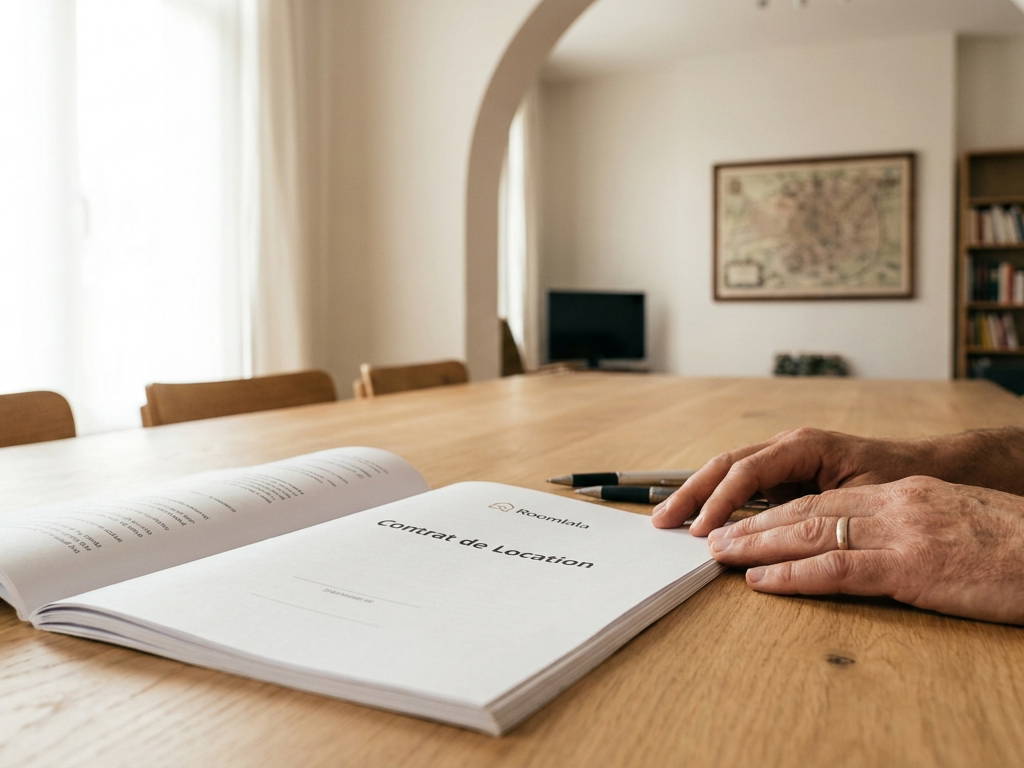
The major novelty of 2026 lies in the strict obligation to request, verify, and keep proof of your tenant's temporality. This is no longer a simple formality or good practice, but an essential legal obligation to protect your rights as a host. The LAU temporary contract must explicitly mention the cause of the temporality and attach the corresponding evidence.
Which documents are considered valid by the authorities? The list is specific but logical. You must ask your future tenant to provide you with official documents such as:
- An internship agreement signed by a local company.
- A fixed-term employment contract or a mission letter from an employer.
- A certificate of enrollment at a university or school (Erasmus, master's, etc.).
- A medical certificate justifying temporary treatment in the region.
- Proof of primary residence in another city or country.
At Roomlala, we advise you to include a specific clause in your rental contract clearly stating that the lease is granted exclusively due to the temporary reason justified by the attached document. For example, if you are hosting Maria, an Italian student coming for an Erasmus semester in Madrid, her certificate of enrollment at the Complutense University will be the centerpiece of your contract, ensuring total peace of mind regarding the law.
Registration and regional regulations: focus on Catalonia
The administrative landscape has also seen twists and turns in 2026. Following a highly commented decision by the Supreme Court in May 2026, the unique national registry (NRUA), which was meant to centralize all seasonal contracts, was canceled. However, be careful not to let your guard down: this cancellation at the national level in no way removes the registration obligations at the regional and local levels, which remain strictly in force and are severely monitored.
Catalonia is the perfect example of this regional rigor. Since Law 11/2025 came into force on January 1, 2026, the region has taken a firm stance. Seasonal rentals located in so-called "stressed" areas (residential areas with high demand) are now subject to the same rent limits as standard leases. The goal is clear: to prevent hosts from switching to seasonal leases solely to increase rents beyond legal caps.
If you are a host in Barcelona or its surroundings, you must imperatively consult the Generalitat's rent price reference index. Whether you rent for 6 months or 5 years, the requested rent cannot exceed this cap if your property is located in a stressed area. This is crucial data to include in your profitability calculation to avoid heavy financial penalties.
The Spanish room rental law: What changes for shared housing
Room rentals (alquiler de habitaciones) have long been considered a gray area of the Spanish real estate market, escaping many regulations. But the new national decree approved in the summer of 2026 has changed the game. The Spanish room rental law now regulates this practice strictly for the first time, in order to prevent hosts from circumventing the Ley de Vivienda caps by dividing their housing.
Just as with an entire home, the rental of an individual room must now be justified by a temporary reason if you want to avoid the tenant establishing their permanent residence there. The summer 2026 decree mandates that each room contract must specify the cause of the housing need, otherwise the tenant's rights will align with those of a standard long-term lease.
The most critical point of vigilance concerns rent caps when renting multiple rooms in the same unit, particularly in pioneering regions like Catalonia. The new rule is mathematical and strict: the sum of the rents of the different rooms rented out can no longer exceed the overall rent cap applicable to the entire housing unit according to the reference index.
Let's imagine a use case: you own a 4-bedroom apartment in Valencia or Barcelona, for which the maximum rent authorized by the reference index is €1,200 per month. Previously, you could have rented three rooms at €500 each, thus generating €1,500 in revenue. In 2026, this practice is illegal in stressed areas. The sum of the rents of your three rooms must not exceed €1,200. This measure aims to preserve access to housing, and it is vital to comply with it to avoid deterrent fines.
How Roomlala secures your compliance in 2026
Natural targeting of temporary tenants
Faced with these new legal requirements, it is completely normal to feel overwhelmed. This is where Roomlala acts as your best ally. Using a platform specialized in homestays and medium-term stays is the safest strategy to comply with 2026 seasonal rentals without extra effort.
Roomlala's strength lies in its audience. Our platform naturally attracts profiles whose housing need is intrinsically temporary and easily justifiable: international students, interns, young professionals on probation, or traveling professionals. By publishing your listing with us, you filter requests from the outset and reach an audience that already has the documents required by law.
Thanks to our secure messaging system, you can exchange with your future tenants even before accepting a booking. You have plenty of time to ask them to send you their internship agreement or university admission letter. For example, if you rent a room in Seville, you can easily validate the profile of a student from the University of Seville, collect their supporting document via our interface, and draft your temporary contract in full compliance.
Continuous support for hosts
At Roomlala, we believe our role does not stop at connecting people. We are committed to supporting you in managing your accommodation by keeping you informed of changes to the Spanish room rental law and the best practices to adopt. We know that legislation can vary from one autonomous community to another, and we make it a point of honor to provide you with updated resources.
In addition to facilitating the collection of proof of temporality, Roomlala secures all your financial transactions. Payments are managed online, ensuring you receive your rent on time, while maintaining a clear and transparent record of your rental income, an essential asset in the event of an administrative audit.
Hosting with Roomlala in 2026 means choosing peace of mind. You continue to monetize your available space, meet interesting people, while having the certainty of respecting the legal framework of the LAU temporary contract. Do not wait any longer to bring your property up to standard: publish your listing on Roomlala, target the right profiles, and rent with confidence!





There are no comments yet.
Add a comment
You must be logged in to post a comment.